January 15, 2026
Which Cost-of-Living Number Should You Trust?
Switzerland tops almost every price list in the world - and also the list of where a local salary buys the most. Five ways to measure the cost of living, and why no one publishes an official one.
"Is that an expensive country?" is one of those questions everyone answers instantly and nobody answers the same way. It's a fight that flares up on social media every few months - someone posts a ranking, and everyone else reaches for whichever index backs the point they already held. So I went looking for the number that settles it - built the comparison across five common indices as an interactive piece - and came back with something more annoying than an answer: it depends entirely on which ruler you pick up. Switzerland makes the point better than any argument could.
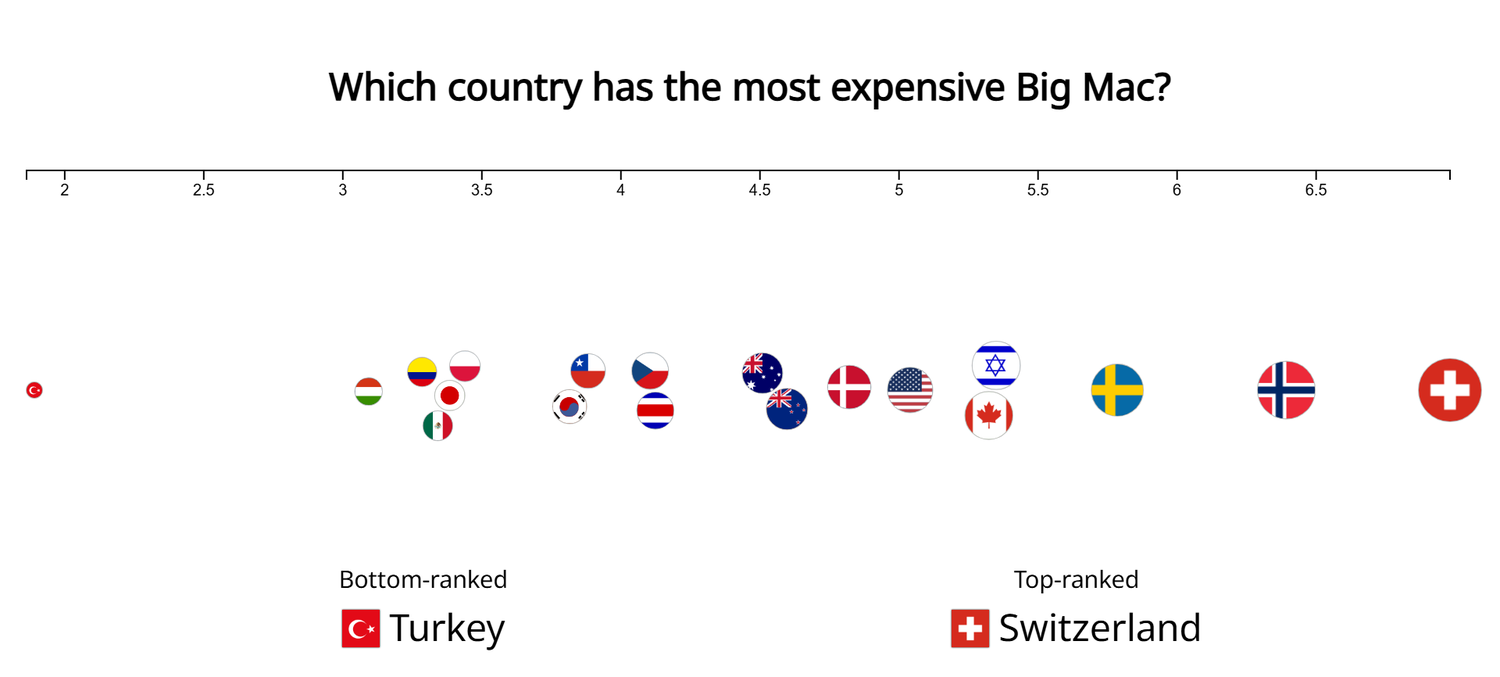
The most expensive country in the world
Start with the yardsticks a tourist would recognize. A Big Mac in Switzerland runs $6.98 - the most expensive of the 55 countries The Economist tracks, ahead of Norway ($6.39) and Sweden ($5.79). A cappuccino is $6.11, second in the world. A one-way transit ticket is $4.13, also second. And the serious measure agrees: the OECD's Price Level Index, which prices a fixed basket of roughly 3,500 goods and services and sets 100 as the OECD average, puts Switzerland at 137 - the second-most-expensive basket in the developed world, a full 37% above average.
Burger, coffee, bus fare, or a basket of thousands of items: by every price yardstick that exists, Switzerland is at or near the very top. If "expensive" meant anything simple, this would be the end of the story.
The same country, cheapest of all
Except every one of those measures has the same deliberate blind spot: they say nothing about what anyone earns. They record what things cost and ignore what people are paid.
So swap in the ruler that puts income back. The Local Purchasing Power Index takes a basket of everyday goods and divides by the local salary - how far your money actually stretches where you both earn it and spend it. On that scale (100 ≈ purchasing power in New York), Switzerland scores 118.4: first out of 139 countries. The most expensive country on Earth is also the one where an ordinary salary buys the most of anywhere.
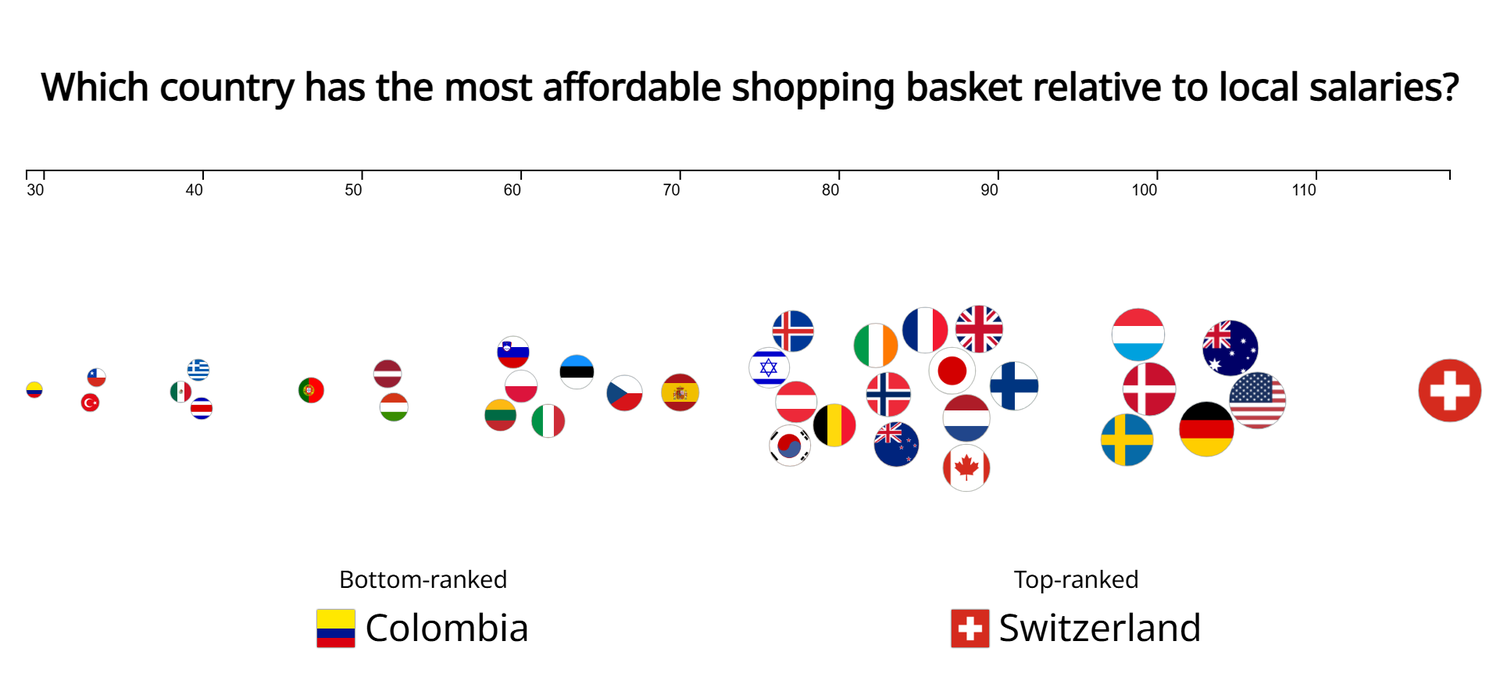
That isn't a paradox once you see what's going on. Swiss prices are very high; Swiss wages are higher still. "Expensive" was never really a property of a country. It's a relationship between prices and pay, and each price index only ever shows you one side of it. Both numbers are true, and they happen to point in opposite directions, so hearing only one of them leaves you confidently wrong.
Pick your index, pick your answer
Once you stop expecting a single number, the whole landscape of "cost of living" indices reads differently. Each one is quietly built for a specific person asking a specific question, and none of them is trying to be the others.
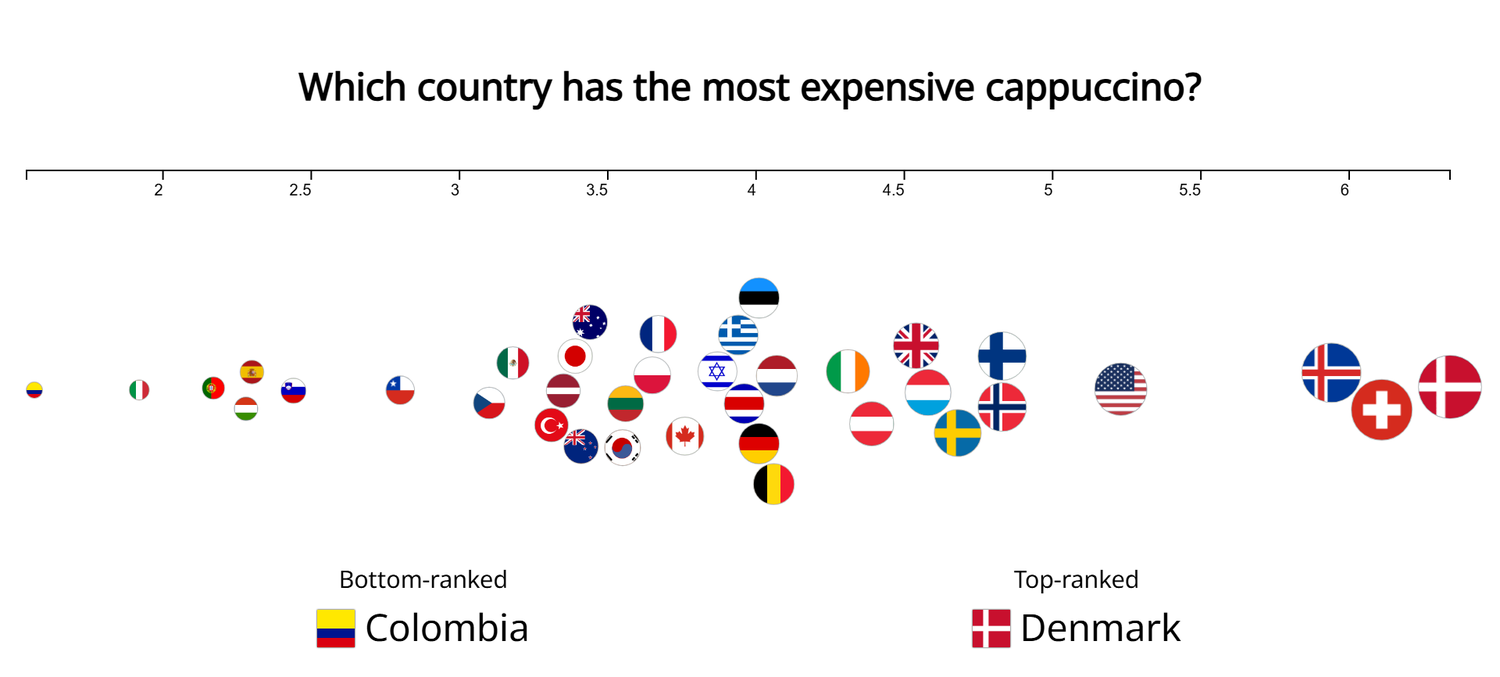
Watch the crown move. The dearest Big Mac is Swiss, but the dearest cappuccino is in Denmark ($6.34), and the dearest bus ticket is in Iceland ($5.03, next to Luxembourg at the bottom of that list - where public transit is free). Three ordinary things, three different champions. Each of these single-product indices is a stand-in for an entire economy, and each carries a warning label about what it can't see: the Big Mac and the cappuccino ignore income and rest on one item; the crowd-sourced ones lean on whoever bothered to report a price online, skewing toward big cities.
Even the purchasing-power index - the one that felt the most complete - divides by the average wage, which, as I've written before, is exactly the number that quietly erases the people at the bottom. A country can look comfortable on average and still be brutal for the half of it earning below that average. Iceland is the tell: near the top on transit and coffee, yet only 28th in purchasing power - expensive to visit and expensive to live in. Switzerland tops the same price lists and sits first in purchasing power. Same "expensive," opposite meaning.
Why there is no official number
Here's the part that surprised me most while building this. You'd assume some authoritative body publishes the cost-of-living index and the rest are novelty acts. They don't. The OECD deliberately declines to - not from neglect, but as a considered refusal, because there's no honest way to crown one.
Their reasoning is worth sitting with, because it's the whole point:
- People consume different things. A single index needs one fixed basket, but one country eats pork, another fish, another barely touches dairy. No basket represents everyone fairly.
- Salaries differ in structure, not just size. Wages, taxes, government benefits, healthcare, pensions - you can't just divide prices by a paycheck and call it what people can afford.
- Nobody agrees on what belongs in it. Only essentials? Education, health, transport too? Do you account for the gap between rich and poor within the country? Each of those is a choice about what counts, not an economic fact you can look up.
So the OECD does the disciplined thing: it publishes the components - prices here, wages there, disposable income separately - and leaves the synthesis to you. It hands you the parts and refuses to pretend there's one right way to add them up.
Which question are you actually answering?
That refusal is the honest one, and it's the same discipline a good data story lives or dies by. We badly want one number, because one number ends the argument. But "how expensive is a country" isn't a single question with a single answer. It's four or five different questions that get asked in the same words, and the useful move isn't to pick a winner, it's to notice which one you're actually asking. A tourist, a new arrival, a minimum-wage worker, and a relocating engineer are not asking the same thing, and any single index that claims to serve all of them is serving none of them honestly.
Which is why picking an index is never neutral. Quote only the price level and Switzerland is a scandal; quote only purchasing power and it's the best deal on the map - and the person doing the quoting almost always has a conclusion in mind first. That's the exact line between a point of view and propaganda: did the number come first, or did the argument? The only defense is to keep every ruler on the table at once, label what each one can't see, and - like the dataset you can always interrogate yourself - let the reader check which question they came in with.
So: is Switzerland expensive? Yes, and also no. It depends on whether you're looking at prices or at what people earn. The most honest cost-of-living index is the one nobody publishes, because it would have to start by asking who wants to know, and why.