September 12, 2019
Nobody Cheated, and Inequality Showed Up Anyway
A perfectly fair little game that ends in a wildly unequal world - and the temptation to make a toy prove far too much.
Here's a bet. Put fifty people in a room and give each of them fifty dollars. Every minute, on a bell, every person hands one dollar to another person in the room, chosen completely at random. No skill. No theft. No one starts richer, no one plays better, nobody gets to aim. The only rule is: give a dollar to someone, anyone, at random, once a minute.
Let it run for an hour. What does the room look like?
Almost everyone I've asked gives the same answer, and it's a reasonable one: it stays roughly equal. Everyone has the same odds every minute, money just sloshes back and forth, so it should hover around fifty each - and if anything, some people expect it to get more even over time, as though fairness in the rules would enforce fairness in the pot.
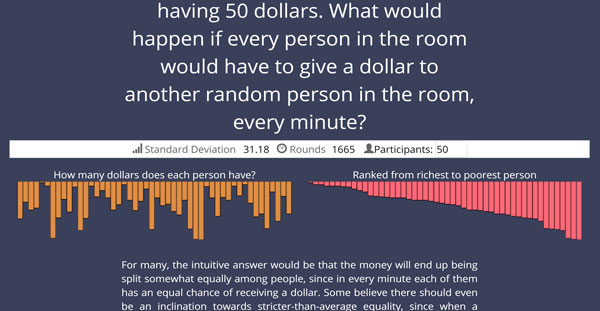
It doesn't stay equal. It isn't close.
Run the little simulation above a few thousand rounds and the room settles into a hard gradient: a handful of people sitting on multiples of what they started with, a long crowded tail near the bottom, and a few flat broke. Sort everyone from richest to poorest and you get that smooth downward slope on the right - and the unsettling part is that it's stable. It doesn't wash out with more time. Leave it running overnight and the specific names shuffle, but the shape stays. The room is permanently unequal, and it got there on rules you'd sign off on with your eyes closed.
Where the inequality actually comes from
There's no villain in the code to point at, which is exactly what makes it interesting. The inequality isn't injected anywhere; it precipitates out of pure randomness.
The engine is just luck compounding. A few unlucky minutes early - you give three times before you receive once - and you're down near the floor, where you have less to work with and a bad run digs a deeper hole. A few lucky ones and you've got a cushion that lets you weather the next drought. Nobody is playing differently; some people just get dealt a better opening sequence, and in a system with memory, the opening sequence sticks.
The single most important detail is the quietest one: you can't give away a dollar you don't have. Hit zero and you sit out until someone hands you one. That's the only asymmetry in the entire system - a floor at zero and no ceiling at the top - and even that isn't unfairness. It's arithmetic. Wealth can't go negative, so the distribution can only splay out in one direction, and the mathematically natural resting shape of "random transfers with a floor" isn't a tidy spike at fifty dollars. It's a spread. The equal start was never the equilibrium; it was just where we happened to begin.
The one thing this actually proves
That's the whole payload, and it's worth saying plainly: a fair process does not guarantee a fair outcome.
Most of us carry the opposite assumption around without noticing it - that if every individual step is above board, the result must be deserved, and a lopsided ending must mean somebody, somewhere, cheated. This toy severs that link in about ninety seconds of watching. Every step here is scrupulously fair, and the ending is lopsided anyway. Unequal outcomes are not, by themselves, evidence of an unfair game.
Which is precisely where it gets dangerous
A demonstration this clean is a loaded gun, and the temptation is to point it at whatever argument you already wanted to win.
I've watched people take the exact same thirty-second clip in opposite directions. One camp: see - wealth is basically luck, nobody really earns anything, so it's all arbitrary. The other: see - inequality is a law of nature, baked into the math, so quit trying to fix it. Both are the model talking way over its pay grade. There is no work in this simulation, no skill, no wages, no inheritance, no markets, no policy, no rich uncle, no tax. It is fifty dollars and a stopwatch. It cannot tell you whether real inequality is fair, or fixable, or deserved, because none of the machinery that produces real inequality is in the box.
So the honest job here is restraint. The moment I let this thing "prove" my politics, I'm doing the precise thing I try hardest to avoid when I build data stories for a living: bending a legible model until it sells a conclusion it never actually contained. The simulator's credibility comes entirely from how little it claims. It kills one specific bad intuition. It installs no replacement. Keep it a toy, and it stays true; promote it to a proof, and it starts to lie.
Why it had to be watched, not explained
I could have written the last thousand words as a single paragraph and you'd have nodded and moved on, because a claim you read is easy to file under "sounds plausible." The reason the thing works is that it had to be watched. You set the room running and see the bars sort themselves in real time - the smooth slope assembling itself out of nothing but coin flips, right in front of you, with no hand on the scale. The animation is the argument. Disbelief doesn't survive watching it happen live.
That's also, I suspect, why Digg picked it up back in 2017. A paragraph asserting "fair rules can yield unfair outcomes" is forgettable. A little machine that makes it happen in front of you, that you can't argue with because you just saw it - that travels.
The best toy models don't hand you a new belief to carry around. They take one wrong belief away and leave your hands empty enough to actually think.